The Zero-Click Shift: Transforming Your Website from a Static Brochure into an AI Training Ground

Most searches now end without a click. Google answers the question in an AI Overview, ChatGPT answers it in a chat window, and the customer picks up the phone without ever visiting a website. That is the zero-click shift, and it breaks the model most business websites were built on: rank, get the click, convert on the page.
The businesses winning in 2026 flipped the model. Their websites are not brochures waiting for a visitor. They are training grounds that teach the AI engines exactly what to say about them, so the recommendation happens before the click ever would have. This guide is how I rebuild a site for that job, from the way pages are written to the way the server answers a crawler. It pairs with my Google Business Profile guide, because the profile and the site have to tell the same story.
What the zero-click shift actually changes
For 20 years the website's job was to earn a click and then persuade. Now a large share of the persuading happens inside the AI answer, using your content, and the customer only reaches your site to book. Three things follow from that.
- Your pages are read by machines more often than by people. Crawlers from Google, OpenAI, Anthropic and Perplexity visit far more than humans do, and what they extract becomes the answer.
- Being quoted matters more than being ranked. Position 3 on Google with a citation in the AI Overview beats position 1 with none.
- The click that does come is hotter. A visitor who arrives after an AI recommended you is already sold. The page just has to make booking effortless.
So the site needs two layers: a machine layer that is easy to read, quote and trust, and a human layer that converts the warm visitor in seconds. Most sites have neither.
Answer-first architecture: write every page for extraction
AI engines lift passages, not pages. A passage gets lifted when it is self-contained, direct, and sits under a heading that matches the question. That means every service page, location page and blog post should be structured the same way.
Question-shaped headings
Replace "Our Services" with "What does a furnace repair in Naperville cost?" Replace "About Us" with "Who is SEOLEVELUP and who do we work with?" The heading is the query; the first sentence under it is the answer.
The 40-word answer, then the detail
Under each heading, lead with a 1 to 2 sentence declarative answer that would make sense if it were the only thing quoted. Then expand. Engines reward the front-loaded answer and humans skim it the same way.
One page, one intent
A page that tries to rank for roofing, gutters and siding is a page the machine cannot classify. Split it. Each service gets a page, each major city gets a page, and each page mirrors the matching service on your Google Business Profile word for word, which is the corroboration engines look for.
Facts the AI can quote
Prices or ranges, response times, service areas by town, years in business, licenses, warranties, and named people. Vague pages do not get cited because there is nothing to cite. I detail the difference between owning the answer and being the cited source in GEO vs AEO.
Structured data: hand the engine a labeled copy of your business
Schema markup does not force a citation, but it removes doubt about what a page is and who stands behind it. On a local business site I ship these on every build:
| Schema type | Where | What it tells the AI |
|---|---|---|
| LocalBusiness (or the specific subtype) | Homepage and each location page | Name, address, phone, hours, service area, geo, sameAs links to your profiles |
| Service | Each service page | What the service is, who provides it, where, and the price range |
| FAQPage | Any page with real questions and answers | Ready-made question and answer pairs to quote |
| Article or BlogPosting | Every guide | Author, date, publisher: the E-E-A-T facts |
| Person | About page | Who the expert is, with credentials and sameAs links |
| BreadcrumbList | Every page | How the site is organized |
Keep the schema in sync with the visible text and with the Google Business Profile. Contradictions between them are the most common reason a well-built site still gets skipped.
Open the door: crawler access and speed
You cannot be a training ground if the trainers are locked out. Check three things this week.
robots.txt. Allow GPTBot, OAI-SearchBot, ClaudeBot, PerplexityBot, Google-Extended and Applebot-Extended. Many security plugins and CDN rules block them by default "to save bandwidth," which is the same as opting out of AI recommendations.
Rendering. If your key content only appears after JavaScript runs, some AI crawlers never see it. Server-render the text that matters, or at least make sure the raw HTML contains the answers.
Speed and stability. Crawlers have budgets. A site that responds in 300 milliseconds gets read completely and often; a site that takes 4 seconds gets sampled. This is the same discipline that makes the site rank on Google in the first place, which is why I still start every engagement with the SEO foundation.
Teach the engines who you are: entity and authority signals
Retrieval decides which pages could answer the question. Trust decides which one gets named. Trust is built off the page as much as on it.
- A real author. Every guide carries a named person with a photo, a bio, and a Person schema that links to LinkedIn, YouTube and the Google Business Profile. Anonymous content gets treated as anonymous.
- Consistent mentions. Chamber listings, supplier directories, local news, podcasts, sponsorships. Each one is a third party vouching that the entity exists and is what it says it is.
- Reviews that echo the site. When customers describe you the same way your pages do, the engine sees corroboration. This is why the review engineering on the profile side matters so much.
- Original data and opinions. Engines prefer sources that add something: a price survey, a case study with numbers, a clear point of view. A page that restates what everyone else says is a page nobody needs to cite.
The human layer: convert the warm click in seconds
Once the AI has recommended you, the visitor is not researching. They are confirming. Every page they land on needs the same four things above the fold, on mobile first:
- A one-line statement of who you help and where, matching what the AI just said.
- Proof: rating, review count, an award, a recognizable client.
- One primary action: call, text, or book, in a button that is visible without scrolling. Phone numbers are click-to-call, always.
- A fast path to the answer they came for: price, availability, or the specific service.
Everything else is secondary. My website design work is built around this because a site that gets recommended and then fumbles the booking is worse than one that was never recommended: you paid for the visibility and lost the lead anyway.
Prove it: measure citations, not just traffic
Analytics will show falling clicks on informational queries. That is the shift, not a failure. The numbers that tell you whether the training ground is working are different: how many customer questions produce a mention of your business, how often your pages are cited as a source, and how many booked calls say "the AI told me to call you."
Start with the free AI Visibility Checker to get a baseline score across ChatGPT, Gemini, Perplexity and Claude, then re-run it after the rebuild. For the monthly, screenshot-backed version, that is what my GEO service and AEO service deliver. The full system that ties the profile, the site and the prompts together is in The GEO Playbook.
Is your website teaching the AI, or hiding from it?
I rebuild business websites as answer-first, schema-backed, crawler-open training grounds that AI engines cite and warm visitors book from. Book a free strategy call and I will show you which of your pages the engines can and cannot read today.
Check My AI Visibility Free Book My Free Strategy CallFrequently asked questions
What is zero-click search?
How do I make my website show up in ChatGPT answers?
Which AI crawlers should I allow in robots.txt?
Does schema markup help with AI visibility?
Is a zero-click world bad for my business?
How do I measure whether AI engines cite my website?
Where to go next.
Search visibility is one system. These guides cover the rest of it.
 Google Business Profile
Beyond the Map Pack: Engineering Your Google Business Profile for AI-Driven Recommendations
Read this next if you want the AI engines to recommend you by name, starting with your Google profile.
Read the guide →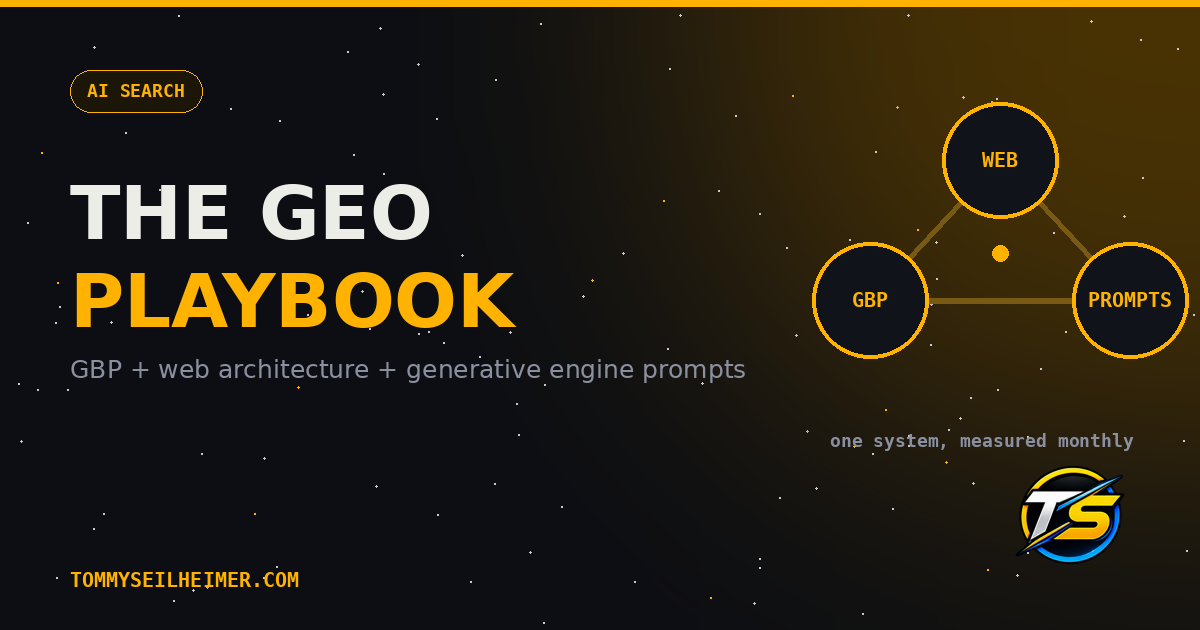 AI Search
The GEO Playbook: Bridging GBP, High-Converting Web Architecture, and Generative Engine Prompts
Read this next if you want the whole GEO system in one place, in the order I actually run it.
Read the guide → AI Search
GEO vs AEO: How to Get Cited by ChatGPT and Gemini
Read this next if you want the citation mechanics, engine by engine.
Read the guide → SEO
The SEO Foundation Every Business Needs in 2026
Read this next if you want the short version of what has to be true before any of this works.
Read the guide →