YouTube SEO: How I Grew a Channel Past 243,000 Subscribers, and How Video Ranks Your Business
YouTube SEO is the work of making your videos rank inside YouTube, inside Google search results, and inside AI answers, by optimizing the channel, each video’s metadata, viewer retention, and the way the video is embedded and marked up on your website. Done properly it gives a business three new places to be found, and it feeds the AI engines the one source type they cite most eagerly.
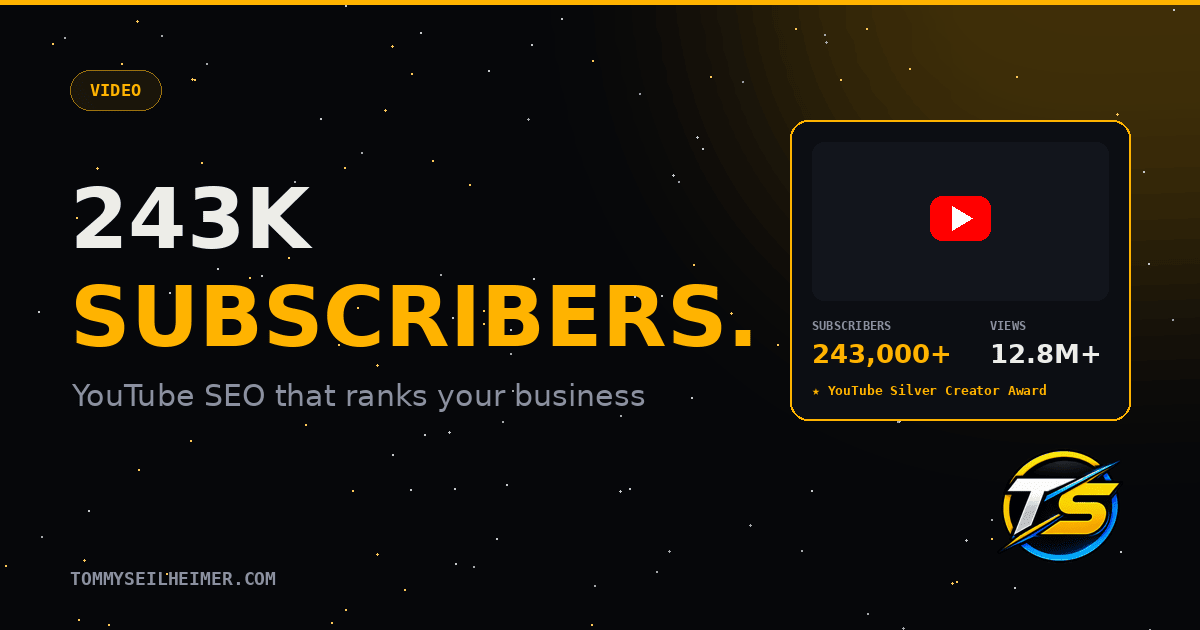
I have helped grow 3 award-winning YouTube channels. The largest is The REKAP with David Kaplan, the Chicago sports channel that publishes every single day and now stands at more than 243,000 subscribers, 3,700 videos and 12.8 million views, with a YouTube Silver Creator Award to show for it. This article is the playbook behind that growth, translated for a local business that wants the phone to ring. It is the method behind my YouTube SEO service.
One framing before the details. Chicago watches before it calls. A homeowner comparing three roofers will watch the one who explains ice dams on camera. That video ranks on YouTube, appears in Google’s video results, gets embedded on the roofer’s site, and gets quoted when someone asks ChatGPT who to hire. Four surfaces, one piece of content.
Why does YouTube matter for a business that is not a media brand?
YouTube is the second-largest search engine in the world and it is owned by the largest. Google shows video results for a growing share of how-to, comparison and local searches, and those results often appear above the organic links. A business with a well-optimized video answering “how much does a furnace replacement cost in Chicago” can hold a page-one video result for years while competitors fight over the blue links below it.
There is a trust effect too. A two-minute video of the owner explaining the work does what no page of text can: it lets the customer decide they like you before they call. And there is an AI effect, covered below, that has turned video from a nice-to-have into a citation source. Google’s own video best practices spell out what it needs to index and rank a video, and most of it is exactly what follows.
What did it take to grow The REKAP past 243,000 subscribers?
The REKAP launched on April 29, 2022 with a simple format: David Kaplan records a REKAP after every Bears, Cubs, White Sox, Bulls and Blackhawks game. Passion and personality were never the problem. The growth work was making a daily channel discoverable to people who had never heard of it.
What moved the numbers: a channel structured so every video reinforced the same entity (Chicago sports, David Kaplan, The REKAP), titles built around the exact phrases fans search after a game, thumbnails engineered for click-through in a crowded feed, consistent publishing that trained both the algorithm and the audience, playlists that turned one video into a session, and a website and social presence that pointed authority back at the channel. The same disciplines, in the same order, are what I run for a plumber. The scale changes. The method does not.
Want the REKAP playbook on your channel?
On a free strategy call I will review your channel and your top competitors’ videos, show you which searches video could win for you, and lay out the first ten videos to make.
Review My ChannelHow do you set up a channel so it can rank?
Most business channels fail before the first video because the channel itself tells YouTube nothing. The setup checklist:
- Name and handle that match the business name everywhere else, so YouTube, Google and AI engines connect the channel to the entity they already know.
- An About section that states what you do, where, and for whom in the first two sentences, with your main services and service area written the way customers search.
- Links to the website, the Google Business Profile and your social profiles, and a link back to the channel from the site. Entity connections run both ways.
- Channel keywords set to your services and cities.
- Playlists planned before videos exist: one per service, one per common question set, one for reviews and results.
- A trailer for new visitors and a featured video for returning ones.
This is the video equivalent of the Google Business Profile work: complete, consistent, and boring in the best way.
What does video-level SEO actually involve?
Every upload gets the same treatment, because YouTube cannot rank what it cannot understand:
- Title. The search phrase near the front, human-readable, under 60 characters where possible. “Furnace Short Cycling? 5 Causes and What It Costs to Fix (Chicago HVAC)” beats “HVAC Tips Episode 4.”
- Description. The first two lines are the pitch and appear in search. Then a real summary, timestamps as chapters, your services and area, and links to the relevant page on your site and to booking. A description is a page of content, and I write it like one.
- Chapters. Timestamps that split the video into labeled sections. Google shows key moments from them in search results, and they make long videos skimmable.
- Captions and transcript. Uploaded, corrected captions, not the auto-generated ones. The transcript is what search engines and AI engines actually read. Sloppy captions mean a sloppy transcript.
- Tags and hashtags. Minor signals now, but free. Services, cities, the question the video answers.
- End screens and cards pointing to the next relevant video and to your site.
The mindset is that every video is a page. It has a title, a description, structured sections and links. Treat it like a page and it ranks like one.
Why do thumbnails and titles decide everything?
YouTube ranks on engagement, and engagement starts with the click. Two videos with identical content and identical SEO will perform completely differently if one has a thumbnail people click and the other does not. Click-through rate is the first gate.
What works, across every channel I have touched: a real face with a real expression, three to five words of large, high-contrast text that promise the payoff, a consistent visual system so subscribers recognize you in the feed, and no clutter. The REKAP’s thumbnails are instantly recognizable in a feed of hundreds because the system never changes. A business channel needs the same discipline: same colors, same layout, same type, video after video.
Titles and thumbnails are designed together, as a pair, and I test them. YouTube now lets you A/B test thumbnails directly, and a 2 percent difference in click-through compounds into thousands of views over a year.
How does retention drive rankings?
After the click, YouTube watches how long people stay. Retention is the strongest ranking signal on the platform, and it is where most business videos die: a 40-second logo intro, a slow wind-up, and the viewer is gone before the point.
The fixes are editorial, not technical. Open with the answer or the promise in the first five seconds. Cut everything that does not serve the viewer. Keep videos as long as the content deserves and not a second longer; a tight 90 seconds outperforms a padded eight minutes. Use chapters so people who want one part can jump to it and still count as satisfied viewers. And publish on a consistent schedule, because YouTube rewards channels that give it a predictable supply of watch time.
For a local business the target is not going viral. It is a library of 20 to 50 videos, each answering one question customers ask before they hire, each holding a strong retention curve, each quietly ranking for years.
Key takeaways
- YouTube ranks videos in three places: YouTube, Google search and AI answers. One video, three surfaces, plus your own site.
- Treat every video like a page: title, description, chapters, corrected captions, links.
- Click-through and retention decide rankings. Thumbnails and the first five seconds are the whole game.
- Embed with a lightweight player, add a summary and VideoObject schema, and the video lifts the page it sits on.
- AI engines cite YouTube constantly. Plan videos from the questions customers ask AI.
How do you make a video rank your website too?
The video on YouTube is half the value. The other half is what it does on your website.
Every video gets embedded on the page it belongs to: the furnace video on the furnace repair page, the neighborhood video on that community’s page. Under it goes a written summary and, ideally, the transcript, so the page has real text to rank on. Behind it goes VideoObject schema: the title, description, thumbnail, upload date and duration in structured data, so Google can show the video as a rich result for the page. And the embed is done the way this site does it, with a lightweight facade that loads the real player only on click, so the page stays fast. Page speed is a ranking factor and a conversion factor, and a raw YouTube embed is one of the heaviest things you can put on a page.
Done this way, one video improves the ranking of the page it sits on, earns a video result in Google, ranks inside YouTube, and adds a citation source for AI. That is why video is part of my SEO engagements and not a separate hobby.
Want video that ranks your website, not just YouTube?
I will show you a live example of a video rich result, the schema behind it, and how the embed feeds the page. Then we decide whether video makes sense for your market.
Show Me a Live ExampleHow do AI engines use YouTube?
Ask ChatGPT or Gemini a how-to question and look at the sources. YouTube is cited constantly, because a transcript from a credible, named person answering a specific question is exactly the kind of source a generative engine trusts. It has an author, a date, a clear topic and a corroborating platform behind it.
So the videos I produce for clients are planned from the prompt set I track in EZY.ai: if customers are asking AI “what should a new furnace cost in the Chicago suburbs,” there is a video that answers exactly that, with the answer stated plainly in the first sentence of the transcript, uploaded with accurate captions, and embedded on the page that answers the same question in text. That is GEO and AEO applied to video, and it is one of the most reliable ways I know to earn an AI citation.
How do you measure YouTube SEO?
YouTube Studio gives you impressions, click-through rate, average view duration and traffic sources per video. I watch four things: impressions from YouTube search (is the SEO working), click-through rate (are the thumbnails working), average percentage viewed (is the content working), and traffic from external sources, which shows the website embeds and Google video results doing their job.
Then the numbers that matter to a business: video rich results in Search Console, leads that mention the video, AI citations of the channel in the monthly report, and subscriber growth as a trailing indicator. It all goes into the same monthly reporting as everything else, because video is not a separate channel. It is search.
Which YouTube mistakes waste the most effort?
- Producing one polished commercial instead of twenty useful answers. The commercial gets 80 views. The answers rank for years.
- Auto-generated captions. The transcript is the content. Fix it.
- No description, or a one-line description. That is a blank page.
- Ignoring thumbnails. The best video nobody clicks does not exist.
- A channel that does not name the business or link to the site. The entity connection is the whole point.
- Raw embeds everywhere that tank page speed.
- Publishing twice and quitting. Consistency is the algorithm’s favorite signal.
Every one of these is fixable, and the fixes are the service. If you want the channel that grew The REKAP applied to your business, that is what YouTube SEO and channel growth is. You can read what clients say on the reviews page and browse 500+ answers to questions about every service I offer.
Ready to be the business people watch before they call?
The channel that reached 243,000 subscribers runs on the same playbook I use for local businesses. Book a free strategy call and I will show you where video fits in your plan.
Book My Free Strategy CallFrequently asked questions
What is YouTube SEO?
Does YouTube help a local business rank on Google?
How many videos does a business need?
How long should business videos be?
Do thumbnails really affect rankings?
Do AI engines cite YouTube videos?
Should I embed YouTube videos on my website?
What did it take to grow The REKAP?
Where to go next.
Search visibility is one system. These guides cover the rest of it.
 SEO
The SEO Foundation Every Business Needs in 2026
Read this next if you want the short version of what has to be true before any of this works.
Read the guide → AI Search
GEO vs AEO: How to Get Cited by ChatGPT and Gemini
Read this next if you want to understand how AI answers choose their sources, and why a citation beats a ranking.
Read the guide → Local SEO
How to Win the Google Map Pack in Your City
Read this next if you serve a local area and the Map Pack is where your calls come from.
Read the guide → SEO
What SEO Actually Involves: A Deep Dive Into How I Rank a Business
Read this next if you want the full SEO process, step by step, in the order I actually run it.
Read the guide → AI Search
Generative Engine Optimization: How I Use EZY.ai to Get Your Business Cited by AI
Read this next if you want AI visibility measured and moved month by month, with screenshots.
Read the guide → Local SEO
How I Optimize a Google Business Profile Completely, Field by Field
Read this next if your Google profile is half built. This fills every field.
Read the guide → Reputation
Google Reviews and Reputation: The Complete Playbook, Including How Fake Reviews Get Removed
Read this next if reviews are your tiebreaker and you want the system that earns and protects them.
Read the guide → Reporting
How to Read an SEO Report: The Metrics That Prove Leads, and the Ones That Lie
Read this next if you cannot say what your SEO did last month, and you want a report that proves it.
Read the guide → Consulting
Should You Hire an SEO Agency or Train Your Own Team? The Consulting Model, Explained
Read this next if you have a marketing team and want the method installed inside it.
Read the guide →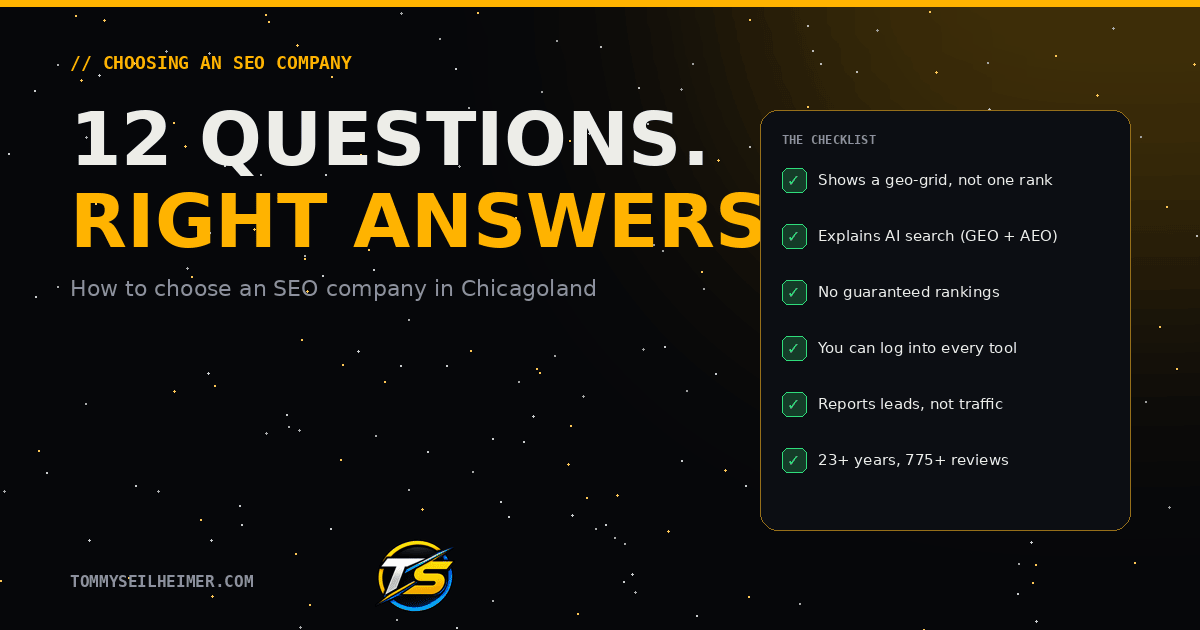 Choosing an Agency
How to Choose an SEO Company in Chicagoland: 12 Questions to Ask, and the Answers That Tell You Everything
Read this next if you are comparing SEO companies and want the questions that reveal which one will actually grow your business.
Read the guide →