Google Reviews and Reputation: The Complete Playbook, Including How Fake Reviews Get Removed
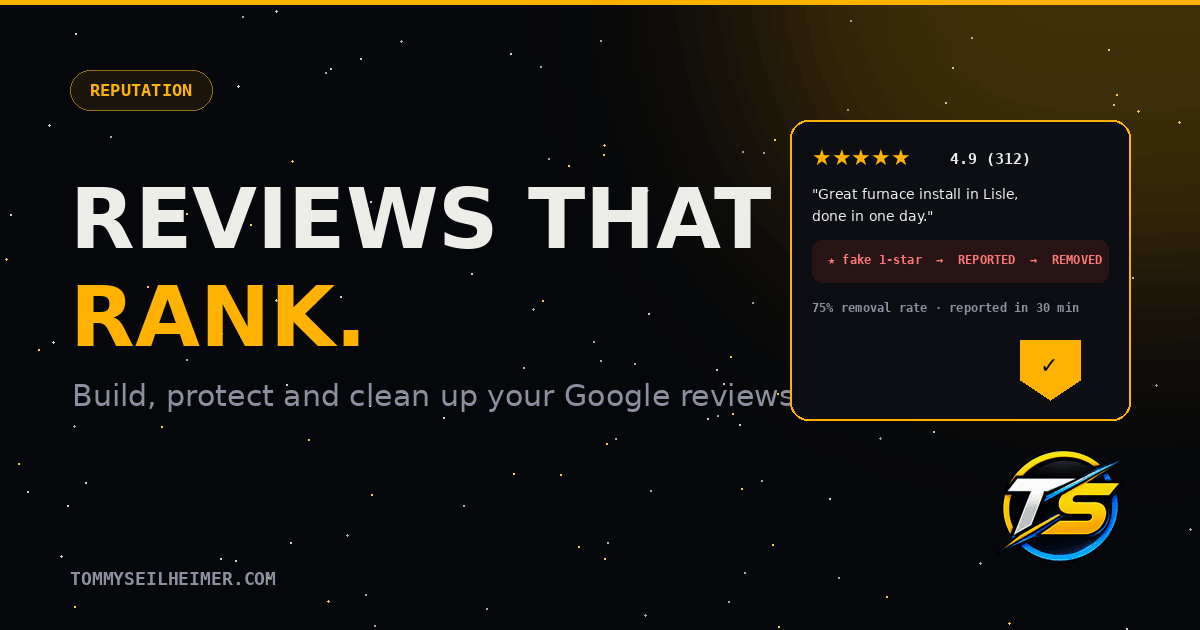
Your Google reviews are a ranking factor, a conversion factor and an AI trust signal at the same time, and reputation management is the work of earning steady, specific reviews, responding to every one, and getting fake, spam and competitor reviews removed before they cost you customers. In a market with dozens of options per category, reviews are the tiebreaker, and Google reads the words in them, not just the star count.
This is the full playbook I run for clients, from the review system that produces the reviews to the GBP Reputation Shield that protects them. It covers what Google rewards, what it removes, what gets a profile suspended, and the numbers behind removal: about a 75 percent removal rate on reported one-star reviews, typically reported within 30 minutes and removed in roughly four days.
Why are reviews a ranking factor and not just social proof?
Google ranks the Map Pack on relevance, distance and prominence, and reviews are the largest prominence signal a business controls. Review count, average rating, how recently reviews arrived, how steadily they arrive, the words customers use and whether the owner responds all feed it. That is the ranking side.
The conversion side is bigger. A customer choosing between three Map Pack listings reads the reviews before anything else, and a listing with 12 reviews from two years ago loses to one with 200 recent ones every time, regardless of who does better work. Google’s own content policy for reviews defines what is allowed on the platform, and everything below stays inside it. The strategy I lay out in how to win the Map Pack depends on this chapter.
What does a review system that actually works look like?
A review system is not a plea. It is a process that runs on every job:
- Ask every customer, every time, at the moment of highest satisfaction: when the job is done and they are happy, not a week later.
- Make it one tap. A direct link to the review form, sent by text within 24 hours, from a name the customer recognizes.
- Automate the follow-up. One reminder two or three days later if no review arrived. Then stop.
- Guide the content without scripting it (next section).
- Track the rate. Reviews requested versus reviews received, per technician or team member. The number goes up when people know it is measured.
- Aim for steady velocity, ten a month for a year, not a burst of a hundred that looks bought.
I set this system up as part of every Google Business Profile engagement, because a profile without a review engine is a profile that decays.
How many reviews are you leaving on the table?
Most businesses ask a fraction of their happy customers and lose reviews to friction. On a free strategy call I will show you your request-to-review rate, your review velocity against the top three competitors, and the system that closes the gap.
Audit My ReviewsWhy do the words in a review matter more than the stars?
Google reads review text. A review that says “great service” is a star. A review that says “replaced our furnace in Lisle in one day and cleaned up after” is a star plus a service keyword plus a city keyword plus a trust detail, and Google uses all of it to decide which searches you are relevant for.
So the ask includes a nudge: “It helps other homeowners if you mention what we did and your town.” No script, no list of keywords to paste, nothing that violates the policy. Just a reason to be specific. Over a year that produces a body of reviews that name every service and every community you serve, which is exactly what the service area strategy needs and exactly what AI engines quote.
How should you respond to reviews, good and bad?
Reply to every review within a day or two, and treat each reply as content, because it is. A reply that thanks the customer and names the service and neighborhood (“Glad the water heater install in Wheaton went smoothly”) reinforces relevance and shows prospects how you treat people.
Negative reviews get the most careful replies of all, because prospects read those first. The pattern: acknowledge quickly, stay calm and specific, never argue, take it offline with a direct contact, and if the review is unfair, say so once, politely, for the benefit of the reader. A gracious reply to a bad review often does more for conversion than five good reviews. Never post a reply while angry and never mention anything that identifies the customer beyond what they shared.
Key takeaways
- Reviews drive Map Pack rankings, conversions and AI recommendations at once. Google reads the words, not just the stars.
- A review system runs on every job: ask at peak satisfaction, one tap, one reminder, steady velocity.
- Reply to everything within a day or two. Replies are content and prospects read the negative ones first.
- Google removes policy violations, not unfair opinions. Correct reporting category is the skill.
- The GBP Reputation Shield: about 75 percent removal on reported one-stars, reported within 30 minutes, about four days to removal.
Which review practices get businesses penalized?
Google’s review policy is enforced, and violations cost rankings or the whole profile:
- No gating. Asking happy customers to post publicly while routing unhappy ones to a private form is prohibited and detectable.
- No incentives. Discounts, gifts or contests for reviews violate policy.
- No employee, family or self reviews, and no reviews from the business’s own devices or network.
- No bulk review stations at the counter that produce clusters of reviews from one location.
- No purchased reviews, ever. They get filtered, and the pattern gets the profile flagged.
A sudden burst of reviews is one of the fastest ways to trigger a filter that hides legitimate ones. Steady wins.
How does Google decide which reviews to remove?
Google removes reviews that violate its policy, not reviews you simply dislike. What gets removed: spam and fake content, reviews from people who never had a customer relationship, conflicts of interest (competitors, former employees), off-topic content, reviews that contain personal information, harassment or hate, and reviews placed on the wrong business. What does not get removed: an unfair but genuine review from a real customer.
The process is reporting the review with the correct policy category and, where needed, escalating with evidence. Category choice matters enormously; the same review reported under the wrong reason gets denied. This is a skill, and it is why the removal rate for an experienced operator is dramatically higher than for an owner clicking “report” in frustration.
How does the GBP Reputation Shield work?
The GBP Reputation Shield is around-the-clock monitoring plus rapid, correctly categorized reporting. Every new review on the profile is screened as it arrives. Anything that looks fake, spam, competitor-planted or abusive is reported, typically within 30 minutes, under the policy category most likely to succeed, with supporting evidence attached where it helps. Denied reports are escalated.
The results across client profiles: about a 75 percent removal rate on reported one-star reviews, and roughly four days from report to removal on average. It is included in my monthly Google Business Profile work, because building reviews without protecting them is building on sand.
Fake or competitor reviews hurting you right now?
Send me the profile. I will screen the reviews, tell you which are removable and under which policy, and get the reports filed today.
Get the ShieldWhat do you do during a competitor review attack?
Competitor attacks are real in crowded categories: a cluster of one-star reviews with no detail, often within hours, often from accounts with no history. The response is a checklist, not a panic:
- Screenshot everything immediately, with timestamps.
- Report each review under the conflict-of-interest or spam category with the pattern documented.
- Reply calmly to each, once, noting for readers that you have no record of the reviewer as a customer.
- Keep the real review flow running so the attack is diluted.
- Escalate denied reports with the full pattern as evidence.
Most coordinated attacks are removed within days when they are documented and reported properly. The damage comes from doing nothing.
Which review platforms matter besides Google?
Google first, always, because it drives the Map Pack. Then the platforms your customers actually use: Facebook for most consumer businesses, Yelp where it still matters for restaurants and services, industry platforms like Healthgrades, Avvo or Houzz, and the Better Business Bureau. Consistency across them corroborates the business for Google and for AI engines, which read reviews across the web when deciding who to recommend.
Two cautions. Do not post reviews you collected yourself on your own site with Review schema and expect Google to show stars; self-serving review markup is not eligible. And do not spread the review ask so thin that no platform builds momentum. Google gets the ask by default; other platforms get it for customers who mention using them.
One more platform that most businesses ignore: your own customers’ voices on video. A 30-second clip of a customer describing the job, embedded on the relevant service page with a written transcript, is a review that ranks, converts and gets cited. It cannot be gamed, it cannot be reported, and it does double duty as YouTube SEO. Three or four of these a year, collected at the same moment you ask for the Google review, build a reputation asset no competitor can copy.
How do you recover a damaged rating?
A profile sitting at 3.6 stars with a string of old complaints is recoverable, and the math is more forgiving than owners expect. Ratings are averages, so volume dilutes: a business at 3.6 with 40 reviews that adds 60 genuine five-star reviews over the next year lands above 4.4. The system in this guide produces that volume; nothing else does.
The order of operations: report and remove everything that violates policy, because some of the damage is usually illegitimate; reply to every remaining negative review calmly and specifically, because prospects judge the reply as much as the complaint; fix the operational problem the honest complaints describe, because the pattern will repeat otherwise; then run the review system hard for twelve months and let the average climb. I have watched profiles go from the low threes to the high fours this way, and the Map Pack rankings recover with the rating, because Google reads the same recovery.
How do reviews affect AI recommendations?
Ask ChatGPT for the best roofer in Naperville and it will name businesses whose reviews it has read. Generative engines weigh review text as corroboration: volume, recency, specificity and sentiment. A business with 200 detailed, recent reviews that mention services and towns is a business the engine can describe confidently. That is a core input to GEO, and the review system above is the cheapest way to feed it. Reviews are also what the engine repeats when it describes you, so the language customers use becomes your AI positioning.
How do you measure reputation?
Monthly: review count and rating on Google and each secondary platform, review velocity (new reviews per month), request-to-review rate, response rate and time, removals achieved, and the share of reviews mentioning a service or a community. Those numbers sit alongside the geo-grid and lead tracking in detailed reporting, because reputation is not a separate project. It is what makes the rest of the work convert.
If your profile has already been damaged, or suspended, the fix starts with reinstatement and then the system above. Questions answered in the FAQ center, and results on the results page.
Ready to build the reputation that wins the tiebreak?
Steady, specific reviews, answered every time and protected around the clock. That is what separates the business that gets the call from the one that does better work and stays invisible. Book a free strategy call.
Book My Free Strategy CallFrequently asked questions
Do Google reviews affect Map Pack rankings?
How do I get more Google reviews without violating policy?
Can Google remove a negative review?
What is the GBP Reputation Shield?
Should I respond to every review?
What is review gating?
Do reviews affect ChatGPT and AI recommendations?
Which review sites matter besides Google?
Where to go next.
Search visibility is one system. These guides cover the rest of it.
 SEO
The SEO Foundation Every Business Needs in 2026
Read this next if you want the short version of what has to be true before any of this works.
Read the guide → AI Search
GEO vs AEO: How to Get Cited by ChatGPT and Gemini
Read this next if you want to understand how AI answers choose their sources, and why a citation beats a ranking.
Read the guide → Local SEO
How to Win the Google Map Pack in Your City
Read this next if you serve a local area and the Map Pack is where your calls come from.
Read the guide → SEO
What SEO Actually Involves: A Deep Dive Into How I Rank a Business
Read this next if you want the full SEO process, step by step, in the order I actually run it.
Read the guide →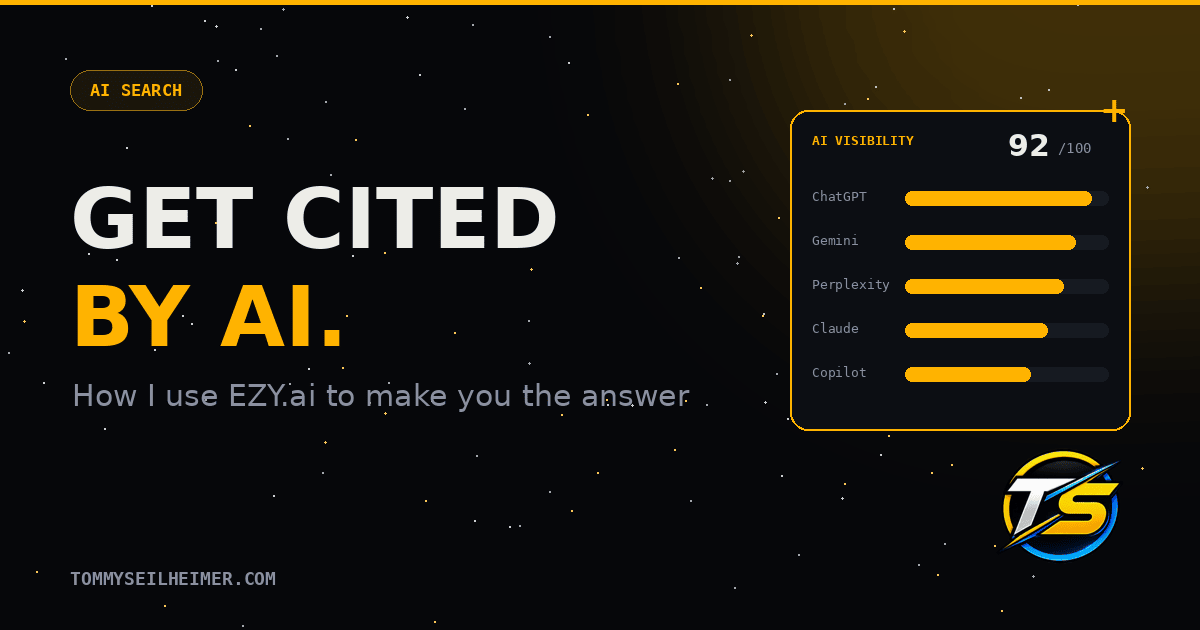 AI Search
Generative Engine Optimization: How I Use EZY.ai to Get Your Business Cited by AI
Read this next if you want AI visibility measured and moved month by month, with screenshots.
Read the guide → Local SEO
How I Optimize a Google Business Profile Completely, Field by Field
Read this next if your Google profile is half built. This fills every field.
Read the guide → Video
YouTube SEO: How I Grew a Channel Past 243,000 Subscribers, and How Video Ranks Your Business
Read this next if you want the playbook that grew a channel past 243,000 subscribers, applied to your business.
Read the guide → Reporting
How to Read an SEO Report: The Metrics That Prove Leads, and the Ones That Lie
Read this next if you cannot say what your SEO did last month, and you want a report that proves it.
Read the guide → Consulting
Should You Hire an SEO Agency or Train Your Own Team? The Consulting Model, Explained
Read this next if you have a marketing team and want the method installed inside it.
Read the guide → Choosing an Agency
How to Choose an SEO Company in Chicagoland: 12 Questions to Ask, and the Answers That Tell You Everything
Read this next if you are comparing SEO companies and want the questions that reveal which one will actually grow your business.
Read the guide →