Should You Hire an SEO Agency or Train Your Own Team? The Consulting Model, Explained
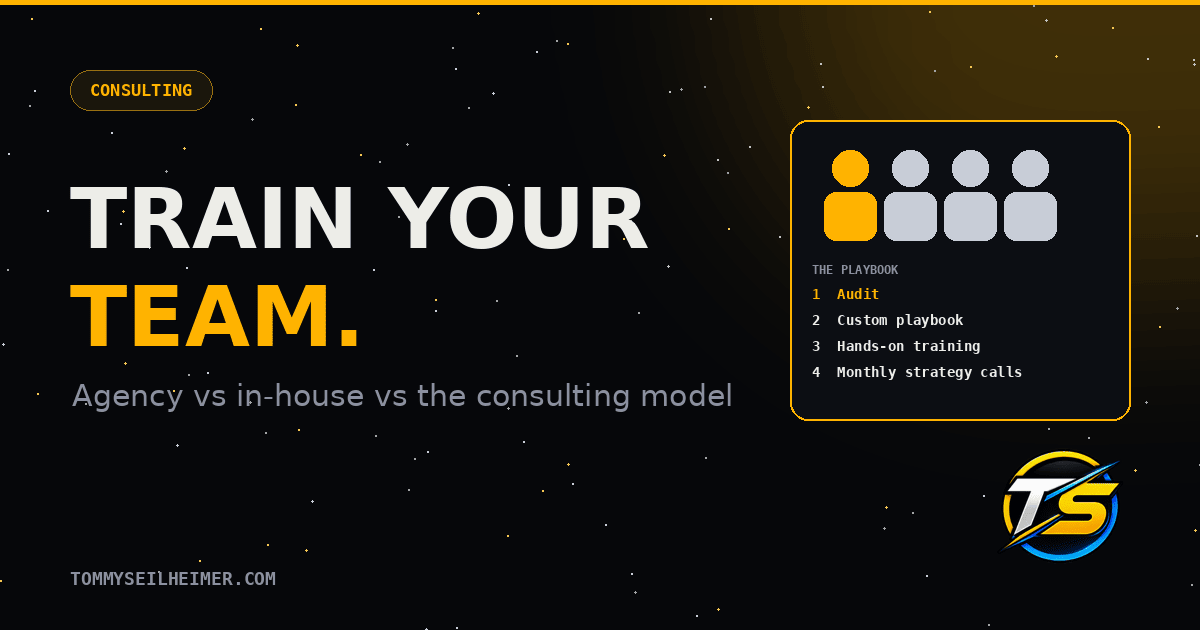
Marketing consulting is the model where an expert installs the complete SEO, Google Business Profile, GEO and AEO playbook inside your own team through an audit, a written playbook, hands-on training and monthly strategy calls, so your people run it and you keep the results, instead of renting execution from an agency forever. For the right business it is the highest-leverage option in search marketing. For the wrong one it is wasted, and this article is honest about which is which.
I offer consulting as an advisor, not a vendor, and I give away everything: the same audit I run for clients, the same playbook, the same monthly rhythm. What follows compares the three ways to get search done, shows what the consulting engagement contains, and lays out the first 90 days. If you have a marketing team and no proven strategy, this is written for you.
What are the three ways to get SEO done?
Agency. You pay a monthly retainer and the agency does the work: audits, pages, profile, content, links, reporting. You get execution without building capability. Quality ranges from excellent to a monthly PDF and nothing else, which is why I wrote how to read an SEO report.
In-house from scratch. You hire or assign a marketer and they learn as they go. Cheapest on paper, slowest in practice, and the learning curve is measured in years of Google updates. Google’s own guide on whether you need an SEO describes what to look for; it does not shorten the curve.
Consulting, the hybrid. An expert audits, writes the playbook for your specific business, trains your team hands-on, and stays on a monthly call to steer. Your team executes. You own the skill, the assets and the momentum, and the monthly cost falls after the install.
What does each option really cost?
| Agency | In-house from scratch | Consulting | |
|---|---|---|---|
| Monthly cost | Several hundred to several thousand dollars, ongoing | A salary or a share of one, plus tools | Front-loaded audit, playbook and training, then a smaller monthly retainer for strategy calls |
| Time to competence | Immediate, but it stays with the agency | One to three years | Ninety days to a running system |
| Who owns the skill | The agency | Your marketer, eventually | Your team, from month one |
| Risk | Paying for reports, not work | Years of trial and error during which competitors win | Team does not execute the playbook |
| Best when | No internal marketing capacity | Budget is the only constraint and time is not | You have people, you need the method |
The consulting math works because the expensive part of search, knowing exactly what to do and in what order, is front-loaded and paid once, while the ongoing work is done by people you already pay.
What does a consulting engagement include?
- The audit. The same full diagnosis I run for any client: site crawl, Search Console, Google Business Profile, competitor gap analysis, keyword and intent map, geo-grid baseline and AI visibility baseline. Your team sees exactly where you stand and why.
- The custom playbook. A written, prioritized plan for your business: what to fix, build and publish, in order, with the standards each piece must meet. Not a generic course. A plan with your pages, your services and your cities in it.
- Hands-on training. Working sessions where your team does the work with me: rebuilding a service page, optimizing the profile, setting up the review system, building a location page, reading a geo-grid, running the AI prompt set. They leave able to repeat it.
- Monthly strategy calls. Review the numbers, correct course, decide the next month’s priorities, answer whatever came up. The playbook stays current as Google and the AI engines change.
The playbook covers everything I do: SEO, Google Business Profile, GEO, AEO, reviews and reputation, video, and reporting. The full methods are already documented in my guides; consulting is applying them to you, with me in the room.
Not sure whether consulting fits your team?
Tell me who you have and what they can give it. On a free strategy call I will tell you plainly whether consulting, an agency engagement or a hybrid makes sense, and what each would cost you.
Check the FitWho is consulting right for, and who should not do it?
Consulting fits a business with at least one person who can give search real weekly hours, a leadership team that wants to own its marketing rather than outsource it, multi-location or growing companies where agency retainers scale badly, and organizations with a content or web capability that simply lacks direction.
Consulting does not fit a business with nobody to execute. A playbook nobody runs is a document. If you are a two-person shop where both people are on job sites all day, hire an agency, and I will tell you that on the first call. The worst outcome is paying for training that never becomes work, and I would rather turn the engagement down than sell it.
Key takeaways
- Three options: agency executes for you, in-house learns for years, consulting installs the method in your team in 90 days.
- The consulting engagement: audit, custom playbook, hands-on training, monthly strategy calls.
- It fits businesses with people and no method. It does not fit businesses with nobody to execute, and I will say so.
- Front-loaded cost, then a smaller monthly retainer. Your team owns the skill and the assets.
- Evaluate a consultant on current practice, real results, a playbook specific to you and AI search coverage.
What does your team need to run the playbook?
Less than people expect. One owner of the playbook who can commit roughly a day a week, someone who can edit the website (or a developer on call), someone who can write clearly, and access to the tools: Google Search Console, Google Business Profile, analytics, a geo-grid rank tracker, and an AI visibility platform. Budget for the tools is modest. The scarce ingredient is consistency, which is what the monthly call protects.
A realistic week for the playbook owner looks like this: two hours reviewing the numbers and the geo-grid, two hours on the next service or location page, an hour on the profile (posts, photos, review replies, Q&A), an hour on outreach and citations, and an hour on the AI prompt set and the knowledge base. That is a day, spread across the week, and it compounds. Most businesses already have someone spending that time on marketing that produces nothing measurable; the playbook redirects it.
What do the first 90 days look like?
| Weeks | Focus | Output |
|---|---|---|
| 1 to 2 | Audit and baseline | Written diagnosis, keyword and intent map, geo-grid and AI baselines, prioritized playbook |
| 3 to 6 | Foundation training | Technical fixes made, Google Business Profile rebuilt by your team with me, review system live, first service pages rebuilt to standard |
| 7 to 10 | Content and location training | Location pages and question content in production, on-page standard internalized, schema in place |
| 11 to 13 | Authority, AI and reporting | Citation and outreach process running, AI prompt set tracked, first full monthly report produced by your team and reviewed together |
After week 13 the engagement drops to the monthly strategy call. The team is running the system, and my job is to keep it pointed at the right targets.
Want to see what a custom playbook looks like?
I will walk you through a real playbook structure on a free call, show you the training format, and map your first 90 days before you commit to anything.
Show Me a PlaybookWhat does the monthly strategy call actually cover?
The monthly call is where the playbook stays alive. A typical agenda: the numbers first, leads by source, the geo-grid, Search Console movement, profile engagement and the AI prompt results, read together so the team learns to see the story in them. Then what shipped last month against the plan and what slipped, without blame and with a fix. Then the next month’s priorities, chosen from the playbook based on what the numbers said: the neighborhood that is still red, the service page that is climbing and deserves a video, the competitor who suddenly gained reviews. Then whatever changed in the landscape, a Google update, a new AI feature, a new local competitor, and what it means for the plan.
The call is recorded so the team can replay it, and the decisions go into the playbook so the document reflects the current plan, not the plan from the kickoff. Over a year those calls are the difference between a team that ran a program and a team that built a capability. It is also where I catch the drift that kills most in-house efforts: the month the review asks stopped, the page that went live without its schema, the tracking number that got swapped out. Small things, caught early, on a call that is already on the calendar.
How do you evaluate a consultant?
- Do they still do the work? A consultant who stopped practicing five years ago is teaching five-year-old search. I run client campaigns every day, and the playbook is what is winning right now.
- Can they show results? Not testimonials about the training. Rankings, geo-grids, leads. Mine are on the results page.
- Is the playbook specific to you? Ask to see a sample. A generic course is not consulting.
- Do they cover AI search? If the plan stops at Google, it is already behind.
- Will they tell you no? A consultant who says consulting fits everyone is selling, not advising.
Why give away the secrets?
Because there are no secrets. Everything in search is knowable; what is rare is doing it completely, in order, for a long time. I publish the full methods in my guides, I answer 500 or more questions in public, and I teach the playbook to teams because the businesses that execute it win, and I would rather be the reason they won than the reason they could not afford to. The clients on my reviews page include both agency clients and teams I trained. The results are the same. The difference is who did the work.
Which consulting mistakes waste the investment?
- No owner. Training a group with no single person accountable produces a group that assumes someone else is doing it.
- Skipping the audit. Training on the wrong priorities is expensive practice.
- Treating the playbook as a course. It is a working document that changes with your business and with Google.
- Dropping the monthly call. That is when playbooks go stale and momentum dies.
- Measuring training instead of leads. The point is customers, tracked the way real reporting tracks them.
If you have the team and want the method, consulting is the highest-leverage thing I offer. If you do not, I will say so and point you to the right service.
Ready to own your marketing instead of renting it?
Audit, playbook, hands-on training, monthly calls. Your team runs it, you keep the results. Book a free strategy call and I will tell you honestly whether it fits.
Book My Free Strategy CallFrequently asked questions
What is marketing consulting for SEO?
Is consulting cheaper than hiring an agency?
Who should not use the consulting model?
What does the consulting engagement include?
How long does it take to install the playbook?
What does my team need?
Does the playbook cover AI search?
Why would you give away your methods?
Where to go next.
Search visibility is one system. These guides cover the rest of it.
 SEO
The SEO Foundation Every Business Needs in 2026
Read this next if you want the short version of what has to be true before any of this works.
Read the guide → AI Search
GEO vs AEO: How to Get Cited by ChatGPT and Gemini
Read this next if you want to understand how AI answers choose their sources, and why a citation beats a ranking.
Read the guide → Local SEO
How to Win the Google Map Pack in Your City
Read this next if you serve a local area and the Map Pack is where your calls come from.
Read the guide → SEO
What SEO Actually Involves: A Deep Dive Into How I Rank a Business
Read this next if you want the full SEO process, step by step, in the order I actually run it.
Read the guide → AI Search
Generative Engine Optimization: How I Use EZY.ai to Get Your Business Cited by AI
Read this next if you want AI visibility measured and moved month by month, with screenshots.
Read the guide → Local SEO
How I Optimize a Google Business Profile Completely, Field by Field
Read this next if your Google profile is half built. This fills every field.
Read the guide → Video
YouTube SEO: How I Grew a Channel Past 243,000 Subscribers, and How Video Ranks Your Business
Read this next if you want the playbook that grew a channel past 243,000 subscribers, applied to your business.
Read the guide →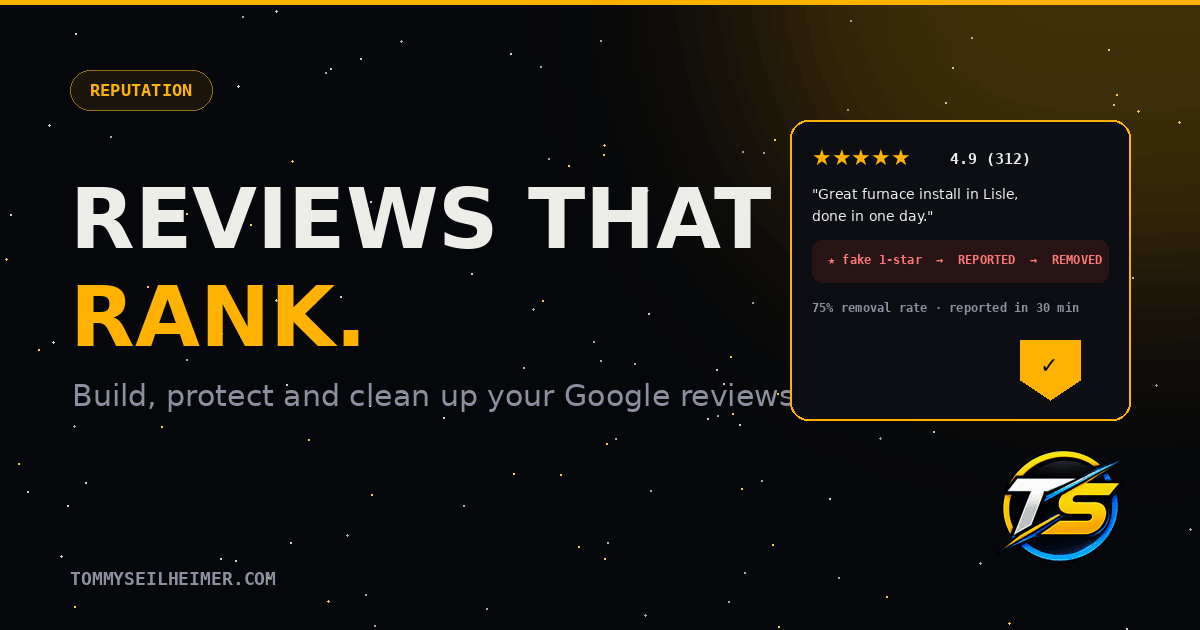 Reputation
Google Reviews and Reputation: The Complete Playbook, Including How Fake Reviews Get Removed
Read this next if reviews are your tiebreaker and you want the system that earns and protects them.
Read the guide →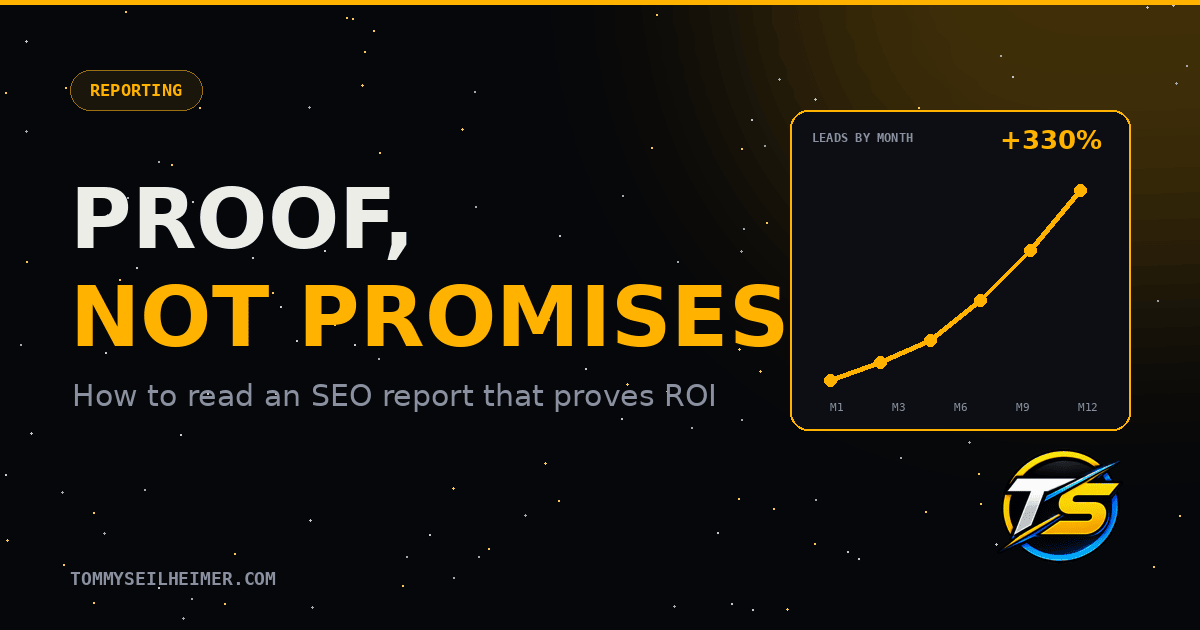 Reporting
How to Read an SEO Report: The Metrics That Prove Leads, and the Ones That Lie
Read this next if you cannot say what your SEO did last month, and you want a report that proves it.
Read the guide →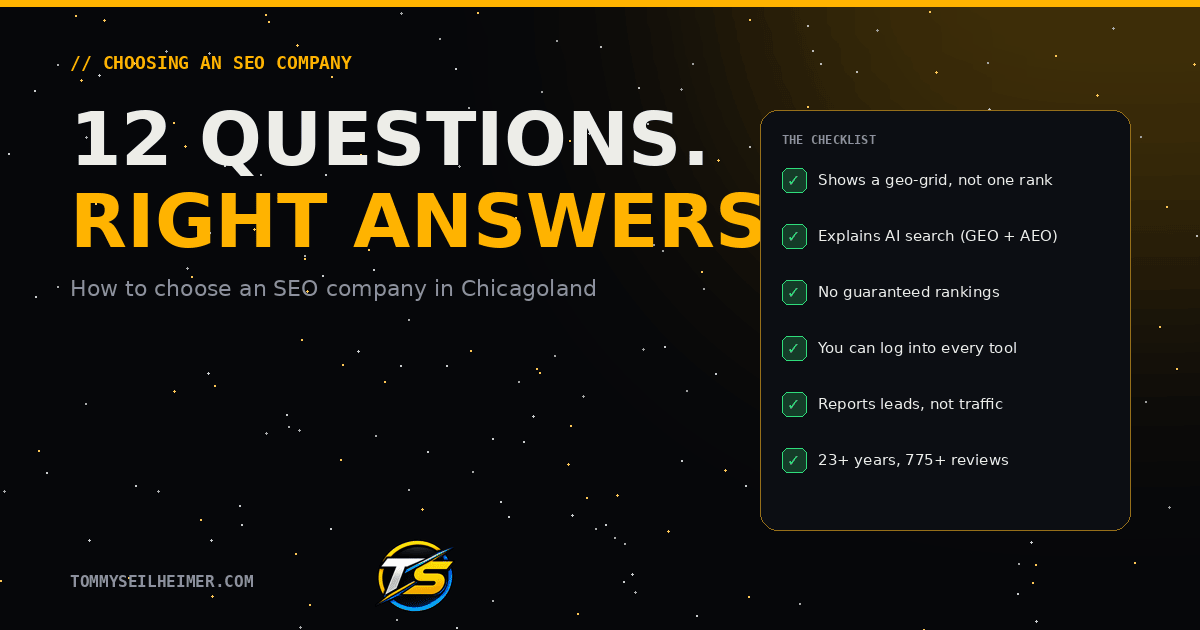 Choosing an Agency
How to Choose an SEO Company in Chicagoland: 12 Questions to Ask, and the Answers That Tell You Everything
Read this next if you are comparing SEO companies and want the questions that reveal which one will actually grow your business.
Read the guide →