The GEO Playbook: Bridging GBP, High-Converting Web Architecture, and Generative Engine Prompts
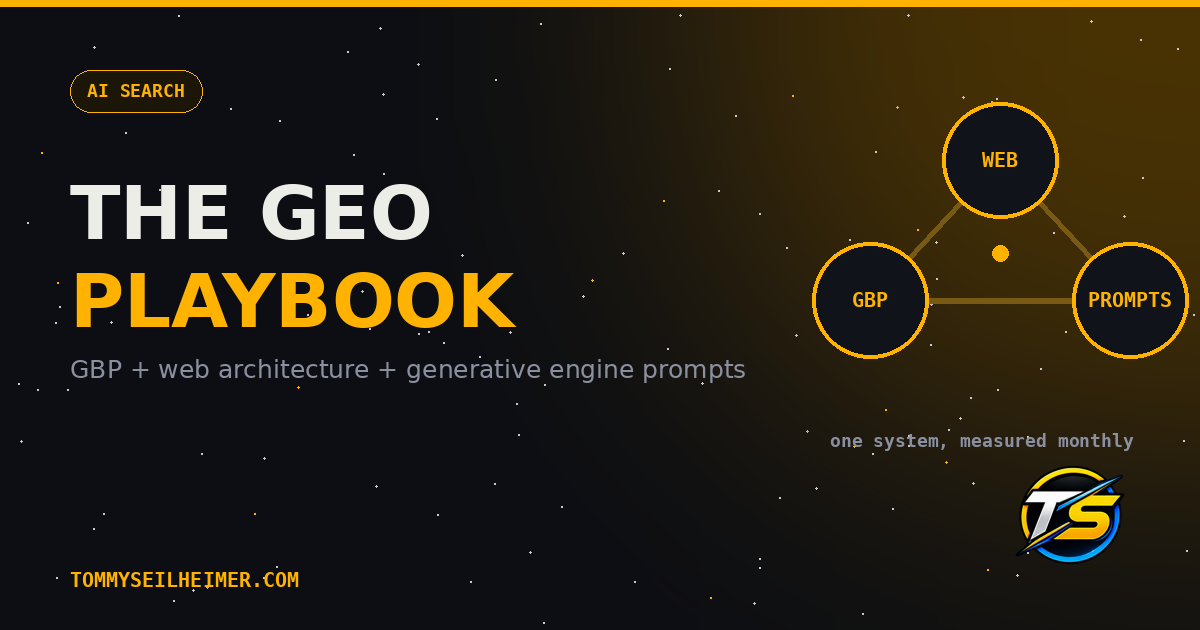
Generative Engine Optimization is not a tactic. It is a system with 3 parts that have to agree with each other: the Google Business Profile that supplies the facts, the website that supplies the depth and the conversion, and the prompts customers actually type into the engines. Most businesses work on one of the 3 and wonder why nothing moves. This playbook connects them.
It is the operating manual behind my GEO engagements, condensed. The two companion guides go deeper on each half: Beyond the Map Pack covers the profile, and The Zero-Click Shift covers the website. Read this one first for the map, then those two for the terrain.
The 3-part system, and why each part fails alone
| Part | What it supplies | What happens if it is the only thing you fix |
|---|---|---|
| Google Business Profile | Verified facts: name, categories, services, hours, reviews, photos | The AI knows you exist but has no depth to quote and no reason to trust you over the next listing |
| Website architecture | Quotable answers, schema, authority, and the booking path | Great content the engines cannot corroborate against a thin or contradictory profile |
| Generative engine prompts | The real questions customers ask, in their words | You optimize for the questions you think matter instead of the ones being asked |
GEO works when the same facts, in the same words, show up in all 3 places, and when you measure the result in the engines themselves rather than in a rank tracker.
Part 1: Start with the prompts, not the keywords
Keyword research tells you what people type into Google. Prompt research tells you what they ask an assistant, and the two are not the same. "plumber naperville" becomes "I have a leaking water heater in Naperville and need someone today, who should I call?" The prompt carries urgency, location, a service, and a decision. Your whole system should be built to answer that sentence.
Build the prompt set
For each core service, write the 8 to 10 questions a customer would ask an assistant: best, top rated, near me, who should I call, recommend, most trusted, best reviews, and the direct "is [your business] good?" check. Add the price question and the emergency question. That is your prompt set, and it becomes your monthly measurement.
Run the prompts and read the answers
Run the set across ChatGPT, Gemini, Perplexity and Claude with web search on, the way a customer would. Record who is named, in what order, and which sources the engine cites. The free AI Visibility Checker does this in one click and lists every competitor and every cited domain. Those two lists are your roadmap: the competitors show you the bar, and the cited domains show you where you need to be present.
Turn prompts into headings
Every prompt in the set becomes a heading somewhere: on a service page, in a Google Business Profile Q&A, in a Post, or in a guide like this one. The answer under each heading is the same 2 sentences everywhere. That repetition is not lazy; it is how you corroborate yourself.
Part 2: Engineer the profile as the fact layer
The profile is where the engines go for the verified basics, so it has to be complete, consistent and fresh. The short version of the full profile guide:
- Exact legal name, one phone number, one website, everywhere.
- Accurate primary category plus every legitimate secondary category.
- Every attribute that is true, revisited twice a year.
- Services and products written the way customers search, with descriptions and prices.
- Reviews that mention the service and the town, with an owner reply on every one within 48 hours.
- Owner-seeded Q&A built from the prompt set.
- A weekly Post that answers a real question, and new photos monthly.
Then mirror it: Apple Business Connect, Bing Places, and the directories the engines cited in your prompt research should carry identical data. If Yelp keeps getting cited for your category, your Yelp page is now part of your GEO, whether you like Yelp or not.
Part 3: Build the website as the depth and conversion layer
The profile answers "who and where." The website answers "why you, how much, and how fast," and then closes the booking. Architecture that does both, from The Zero-Click Shift:
Page structure
One page per service, one page per priority town, each with question-shaped headings, front-loaded answers, and the same service names and prices as the profile. A guide hub, like this blog, for the questions that need 1,500 words instead of 40.
Machine layer
LocalBusiness, Service, FAQPage, Article, Person and BreadcrumbList schema, kept in sync with the visible text. Server-rendered HTML. AI crawlers allowed. Fast response times. An author with a face and credentials on every guide.
Conversion layer
Above the fold on every page: who you help and where, proof, one click-to-call or book button, and the specific answer the visitor came for. The AI did the persuading; the page does the booking. This is the core of my website design work and the reason I never separate design from search.
The bridge: making all 3 parts say the same thing
Here is the discipline that separates GEO from "we did some SEO and some GBP." Every fact about the business lives in one master sheet: name, address, phone, hours, categories, service list with descriptions and prices, service area towns, licenses, guarantees, the 10 owner-approved review prompts, and the prompt set. Every channel is published from that sheet, and any change goes to all channels the same week.
When an engine reads the profile, the site, the schema, three directories and a review, and they all agree, it stops hedging and starts recommending. When they disagree on a single hour or a single service name, you become a maybe. Maybes do not get named.
Authority: earn the mentions the engines already trust
Your prompt research produced a list of cited domains. That list is your outreach plan. If the engines cite the local chamber, join it and get the listing. If they cite a trade association directory, get listed. If they cite local news, pitch a story with real data from your business. If they cite Reddit or Nextdoor threads, be the helpful expert in those threads, without selling.
Add the assets only you can create: a case study with numbers, an annual price survey for your service in your metro, a checklist people actually share. Original data is the fastest route from "a business" to "the source." I walk through the citation mechanics engine by engine in GEO vs AEO.
The monthly cadence I run for every GEO client
- Week 1: Measure. Run the prompt set across all engines, record mentions, positions, competitors and cited sources. Compare with last month.
- Week 2: Fix the fact layer. Update the profile, the master sheet, and every mirror with whatever the report exposed: a missing service, a stale price, a competitor's attribute you lack.
- Week 3: Publish depth. One new or rebuilt page that answers a prompt you are losing, with schema, and a matching Post and Q&A on the profile.
- Week 4: Build authority. One new mention on a domain the engines cite, and a push for 5+ specific reviews that name the service and the town.
Repeat. Structural fixes show up in AI answers within weeks. Being named consistently across engines takes a few months of this cadence, the same arc as ranking on Google did, and it compounds the same way. If you want it run for you, that is exactly what my GEO and AEO services are.
Want the playbook run for your business?
I connect the profile, the website and the prompts into one system, then measure it in the engines every month with screenshots. Book a free strategy call and start with your AI visibility score.
Check My AI Visibility Free Book My Free Strategy CallFrequently asked questions
What is Generative Engine Optimization (GEO)?
How is GEO different from local SEO?
What are generative engine prompts?
Do I need a new website for GEO?
How long does GEO take to show results?
How do I know if GEO is working?
Where to go next.
Search visibility is one system. These guides cover the rest of it.
 Google Business Profile
Beyond the Map Pack: Engineering Your Google Business Profile for AI-Driven Recommendations
Read this next if you want the AI engines to recommend you by name, starting with your Google profile.
Read the guide → AI Search
The Zero-Click Shift: Transforming Your Website from a Static Brochure into an AI Training Ground
Read this next if your website was built to win clicks and the clicks are disappearing.
Read the guide → AI Search
GEO vs AEO: How to Get Cited by ChatGPT and Gemini
Read this next if you want the citation mechanics, engine by engine.
Read the guide →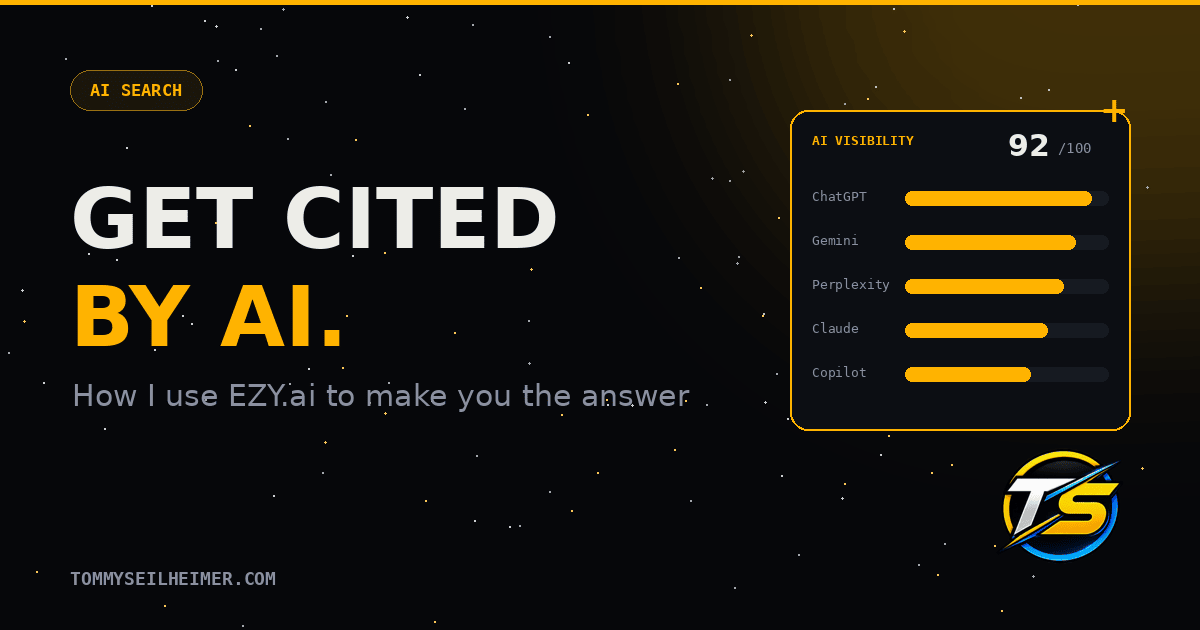 AI Search
Generative Engine Optimization: How I Use EZY.ai to Get Your Business Cited by AI
Read this next if you want AI visibility measured and moved month by month, with screenshots.
Read the guide →